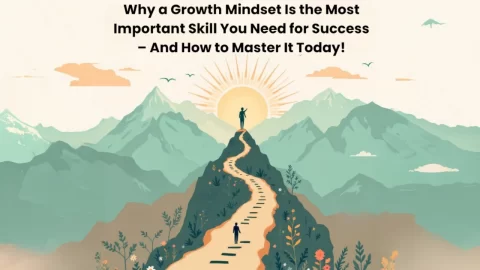


Have you ever wondered why some people rise to greatness while others get stuck where they are? The difference isn’t just talent or luck — it’s mindset.
The world’s most successful people — from Oprah Winfrey to Elon Musk — share one common trait: they all embrace a growth mindset.
Unlike a fixed mindset that believes abilities are static, a growth mindset sees challenges as opportunities and failures as lessons. It’s the ultimate superpower that fuels resilience, innovation, and lasting achievement.
If you’ve ever doubted yourself, feared failure, or felt stuck, this guide will show you exactly how to reprogram your thinking, unleash your potential, and achieve success beyond your wildest dreams.
What Is a Growth Mindset?
The concept of a growth mindset was introduced by psychologist Dr. Carol Dweck from Stanford University.
In simple terms:
- A fixed mindset believes that intelligence, talent, and abilities are innate — you either have them or you don’t.
- A growth mindset believes that abilities can be developed through effort, learning, and persistence.
Example:
- Fixed Mindset: “I’m just not good at math.”
- Growth Mindset: “I’m not good at math yet — but I can improve with practice.”
That single word — yet — can transform your entire life trajectory.
Why a Growth Mindset Matters for Success
A growth mindset doesn’t just help you feel positive — it reshapes how you think, act, and respond to challenges.
People with growth mindsets are:
✅ More resilient during setbacks
✅ More likely to take calculated risks
✅ Better learners and problem-solvers
✅ Higher performers in business, school, and relationships
In short — a growth mindset isn’t just about motivation; it’s about creating lasting change in how you approach success.
Recognizing a Fixed Mindset in Yourself
Before you can grow, you must recognize the mental blocks holding you back.
Here are signs you might have a fixed mindset:
- You avoid challenges for fear of failure.
- You get defensive when receiving feedback.
- You compare yourself to others constantly.
- You believe talent matters more than effort.
- You give up when things get hard.
The good news? Once you notice these patterns, you can change them. Awareness is always the first step toward transformation.
How to Develop a Growth Mindset Step by Step
Let’s break down how to train your brain to think and act like successful people do — consistently and confidently.
Adopt the Power of “Yet”
Start adding the word yet to your self-talk.
Instead of saying:
❌ “I can’t do this.”
Say:
✅ “I can’t do this yet.”
This simple shift rewires your brain to see potential instead of limits. Over time, your language becomes your belief — and your belief becomes your behavior.
Embrace Challenges, Don’t Avoid Them
Growth doesn’t happen in comfort zones. Every challenge is a hidden opportunity to learn and evolve.
When faced with difficulties:
- Reframe your perspective: “What is this teaching me?”
- Remember that every expert was once a beginner.
- Focus on effort over results.
Pro Tip: Keep a challenge journal — write down what you’re learning from each obstacle. This helps you track progress and build confidence.
Reframe Failure as Feedback
Failure isn’t the opposite of success — it’s a part of it.
Every failure gives you valuable data on what doesn’t work. Use that data to refine your approach.
Examples from the greats:
- Thomas Edison failed 1,000 times before inventing the light bulb.
- J.K. Rowling was rejected by 12 publishers before Harry Potter became a global success.
They didn’t fail — they learned. That’s the mindset shift that changes everything.
Focus on Effort, Not Just Outcomes
When you only celebrate results, you miss the magic of progress.
Instead, celebrate effort — because effort builds skill, and skill brings success.
Next time you make progress (no matter how small), reward yourself. That positive reinforcement trains your brain to stay consistent.
Surround Yourself with Growth-Minded People
Your environment shapes your mindset more than you think.
Spend time with people who:
- Challenge you to improve.
- Offer constructive feedback.
- Inspire you with their ambition and persistence.
- Celebrate your progress, not just your perfection.
As motivational speaker Jim Rohn said, “You are the average of the five people you spend the most time with.”
Choose wisely — your circle can either lift you or limit you.
Learn Continuously — Be a Lifelong Student
The world’s most successful people never stop learning. Whether it’s reading, attending workshops, or listening to podcasts, they constantly feed their curiosity.
Daily learning habits:
📘 Read 20–30 minutes a day.
🎧 Listen to growth podcasts or audiobooks.
🧠 Take online courses to upskill.
Remember: Knowledge compounds like interest. The more you learn, the more opportunities you create.
Practice Self-Compassion
Self-growth isn’t linear — you’ll stumble, fall, and fail sometimes. That’s normal.
Instead of being harsh on yourself, show compassion. Speak to yourself the way you’d encourage a friend.
Why it matters:
- Reduces fear of failure.
- Builds emotional resilience.
- Improves motivation and mental well-being.
Growth mindset thrives on grace, not guilt.
Visualize Your Growth and Success
Visualization is a powerful psychological tool used by athletes, entrepreneurs, and leaders.
Picture yourself achieving your goal. Imagine the emotions, the environment, the success. This conditions your mind to believe it’s possible — and your brain starts finding ways to make it happen.
Try this daily:
- Spend 5 minutes visualizing success.
- Write down affirmations that reinforce your belief.
- Take one small step daily toward that vision.
See it. Believe it. Achieve it.
Growth Mindset in Action: Real-World Success Examples
Let’s look at how real people have used the growth mindset to transform their lives.
Oprah Winfrey – Turning Setbacks into Strengths
Oprah’s early life was full of challenges, but instead of giving up, she used every failure as fuel. Her mindset of continuous growth helped her build a media empire and inspire millions.
Michael Jordan – Learning from Missed Shots
Michael Jordan was famously cut from his high school basketball team. Instead of quitting, he worked harder. His growth mindset turned rejection into the drive that made him the greatest basketball player in history.
Sara Blakely – Embracing Failure as a Teacher
The founder of Spanx, Sara Blakely, attributes her billion-dollar success to her father’s advice: “If you’re not failing, you’re not trying.” Her fearless mindset made her one of the most successful female entrepreneurs in the world.
The Science Behind Growth Mindset
Research from Stanford University shows that people with growth mindsets have higher motivation and achievement levels than those with fixed mindsets.
Here’s why:
- Their brains form new neural connections faster.
- They activate areas related to learning and problem-solving.
- They bounce back from setbacks more effectively.
Science confirms what philosophy has preached for centuries — you become what you believe.
Turning Growth Mindset into Daily Habits
It’s not enough to “believe” in growth — you have to practice it daily.
Here are simple ways to make it part of your lifestyle:
- Replace “I can’t” with “How can I?”
- Start a gratitude and learning journal.
- Set weekly micro-goals and celebrate progress.
- Read one new thing every day.
- Reflect weekly on what you’ve learned.
Growth mindset is like a muscle — the more you use it, the stronger it becomes.
Conclusion: Dream Bigger, Work Smarter, Believe Stronger
Mastering the growth mindset isn’t about avoiding failure — it’s about transforming how you respond to it.
Every challenge becomes a lesson. Every setback becomes a setup for a comeback.
When you commit to learning, adapting, and improving daily, success becomes inevitable — and often beyond your wildest dreams.
So stop doubting. Start growing.
Because the future belongs to those who believe they can create it. 🌟
FAQs
Q1: How long does it take to develop a growth mindset?
It varies by person, but consistent practice over a few months can create lasting mental shifts.
Q2: Can a fixed mindset be changed?
Yes. With awareness, self-reflection, and new habits, anyone can transition from fixed to growth mindset.
Q3: What are daily habits to strengthen a growth mindset?
Journaling, reading, goal-setting, and embracing feedback are excellent daily practices.
Q4: Does a growth mindset improve professional success?
Absolutely. It enhances problem-solving, leadership, adaptability, and performance at work.
Q5: What’s the biggest mistake people make when trying to grow?
Expecting instant results. Growth takes time, patience, and consistency.
Internal Links:
- [The Science of Brand Management: How Data Can Boost Your Brand]
- [The Top Trends in Healthcare That Are Too Good to Be True But Are!]
External Links:
- Stanford University – Dr. Carol Dweck’s Research on Mindset (https://www.mindsetworks.com)
- Harvard Business Review – How to Develop a Growth Mindset (https://hbr.org)