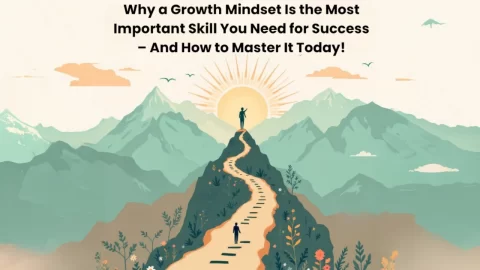

Ever wonder why some people bounce back from failure while others give up? The answer lies in their mindset. A growth mindset empowers you to see challenges as opportunities to learn and evolve, not as roadblocks.
Developing this mindset can completely transform how you approach success, failure, and personal growth. When you shift your focus from perfection to progress, you unlock your potential to achieve goals that once felt impossible.
Let’s explore how adopting a growth mindset can help you overcome any challenge and elevate your life to the next level.
Understanding the Growth Mindset
A growth mindset, a concept popularized by psychologist Dr. Carol Dweck, is the belief that your abilities, intelligence, and talents can be developed through dedication, learning, and persistence.
In contrast, a fixed mindset assumes that your traits are innate and unchangeable. People with fixed mindsets tend to fear failure, avoid challenges, and see effort as fruitless.
But with a growth mindset, every obstacle becomes a learning experience — a stepping stone toward mastery.
Why Your Mindset Determines Your Success
Your mindset shapes how you interpret the world. It determines whether you:
- View difficulties as threats or as opportunities.
- Persist when things get tough or give up easily.
- Celebrate effort or rely only on talent.
A growth mindset encourages resilience, adaptability, and creativity — all essential traits for overcoming life’s toughest challenges.
When you cultivate this mindset, you start seeing potential instead of limitations.
The Science Behind a Growth Mindset
Research shows that your brain is capable of neuroplasticity — the ability to reorganize and form new neural connections throughout life. This means your intelligence and skills aren’t fixed.
When you challenge yourself, your brain grows stronger. Each time you push past your comfort zone, you literally rewire your mind for success.
Studies from Stanford University have found that people who believe they can improve through effort perform better academically and professionally. This proves that mindset is not just motivational fluff — it’s scientifically backed truth.
How a Growth Mindset Helps You Overcome Challenges
When faced with adversity, people with a growth mindset don’t ask, “Why me?” — they ask, “What can I learn from this?”
Here’s how this mindset helps you thrive:
- Turns failure into feedback: Instead of fearing mistakes, you treat them as lessons.
- Builds resilience: You develop mental toughness and emotional control.
- Encourages persistence: You keep going when others stop.
- Promotes creative problem-solving: You look for new ways to achieve results.
Every challenge becomes an opportunity to grow — not a reason to quit.
How to Develop a Growth Mindset
Building a growth mindset takes awareness and consistent effort. Here’s how you can start today:
Embrace Challenges
Stop avoiding difficulties. Challenges are the training ground for your personal evolution. When something feels uncomfortable, it’s a sign you’re growing.
Replace Negative Self-Talk
Words shape your beliefs. Replace “I can’t do this” with “I can learn how to do this.” Positive affirmations help rewire your brain for success.
Focus on Effort, Not Outcome
Instead of obsessing over perfection, focus on improvement. Reward progress, not just results.
Learn from Failure
Every setback holds a lesson. Reflect, adjust, and try again. This process builds confidence and resilience.
Surround Yourself with Growth-Minded People
Your environment shapes your mindset. Connect with people who inspire learning, persistence, and optimism.
Growth Mindset in Action: Real-World Examples
Thomas Edison
When Edison was asked about his 10,000 failed attempts at inventing the light bulb, he said, “I have not failed. I’ve just found 10,000 ways that won’t work.”
That’s a growth mindset in motion — persistence fueled by belief in progress.
Michael Jordan
Jordan, one of the greatest athletes in history, was once cut from his high school basketball team. Instead of quitting, he used that rejection as motivation to practice harder.
Oprah Winfrey
From poverty and adversity to becoming a global media leader, Oprah credits her success to continuous learning and believing that every challenge has a purpose.
These examples prove that mindset, not circumstances, defines your future.
The Role of Self-Reflection in Cultivating Growth
Self-awareness is the foundation of growth. Reflecting on your reactions, beliefs, and progress helps identify areas where a fixed mindset might be holding you back.
Ask yourself:
- Do I give up when things get hard?
- Do I take criticism personally or use it to improve?
- Do I compare myself to others or focus on my own journey?
By answering these honestly, you’ll uncover patterns that can be transformed into growth opportunities.
The Connection Between Growth Mindset and Emotional Intelligence
A growth mindset also strengthens emotional intelligence (EQ) — the ability to manage your emotions and understand others.
When you adopt this mindset:
- You handle criticism more effectively.
- You stay calm under pressure.
- You empathize better with others.
Emotional intelligence, powered by a growth mindset, makes you a better communicator, leader, and problem-solver — both personally and professionally.
How a Growth Mindset Elevates Every Area of Your Life
Career Success
Professionals with growth mindsets adapt faster, learn new skills quickly, and outperform their peers. They view career setbacks as growth opportunities, not failures.
Personal Development
By focusing on progress, you build confidence and self-discipline. Each small victory fuels your motivation for bigger goals.
Relationships
A growth mindset helps you forgive, communicate better, and grow with your partner instead of blaming or withdrawing during conflicts.
Health and Fitness
Instead of chasing perfection, you celebrate consistency. You focus on building habits, not unrealistic results — making healthy living sustainable.
Common Barriers to Developing a Growth Mindset (And How to Overcome Them)
Even with good intentions, old habits can hold you back. Let’s look at common blocks:
- Fear of Failure: Remind yourself that failure is a teacher, not an enemy.
- Perfectionism: Aim for progress. Perfection slows growth.
- Comparison: Focus on your own path — comparison kills joy.
- Negative Environment: Protect your mindset by limiting exposure to negativity.
Growth begins the moment you decide to take responsibility for your thoughts.
Practical Daily Habits to Strengthen Your Growth Mindset
Incorporate these habits into your daily routine:
- Read or listen to inspiring content.
- Journal your progress and lessons learned.
- Set small, achievable goals.
- Practice gratitude daily.
- Celebrate effort, not perfection.
Consistency creates transformation. Every positive action compounds over time.
Conclusion: Progress Over Perfection — Your Next Level Awaits
A growth mindset isn’t about being perfect; it’s about being persistent.
It’s about believing you can improve, even when progress is slow.
When you focus on learning, resilience, and continuous improvement, you unlock your full potential — personally and professionally.
So, the next time you face a challenge, don’t shrink back.
Ask yourself: What can I learn from this? How can I grow?
That’s how you’ll turn obstacles into opportunities and truly take your life to the next level.
Frequently Asked Questions (FAQs)
Q1. What is the main difference between a growth mindset and a fixed mindset?
A growth mindset believes abilities can be developed, while a fixed mindset assumes talent is innate and unchangeable.
Q2. Can a growth mindset really change my life?
Yes. It changes how you approach challenges, failure, and learning, leading to lasting success and self-improvement.
Q3. How can I start building a growth mindset today?
Start by embracing challenges, learning from feedback, and focusing on progress rather than perfection.
Q4. How does a growth mindset affect relationships?
It promotes better communication, empathy, and understanding — helping you grow together with others.
Q5. Are successful people born with a growth mindset?
No. It’s a learned mindset developed through awareness, effort, and persistence.
✅ Internal Links:
- Read more about Building Confidence Through Self-Discipline
- Learn How to Create a Success-Oriented Mindset
✅ External Links: